C'hana
"All are my friends. It is those who are filled with hate that do not seek the good in others."
Hooks
.. Friend of the Steppe
C'hana is an oddity by all accounts for most, whether from the Steppes or not. Evident in her knowledge of the old Auri tongue, as well as a deep understanding of most tribes native to the Azim Steppe, it would not be farfetched that those from the land have met her in their travels... Ally to the Bees
One peculiar hobby that has turned into a spun tale for those on the long and lonesome road is that of a woman who provides various tinctures and curatives all derived from fuzzy flying friends. C'hana does her best to help preserve and protect bees, as well as invent new ways to solve problems with those tiny creatures. There's a good chance some honey you've gotten comes straight from her hives... The Meracydian Outlier
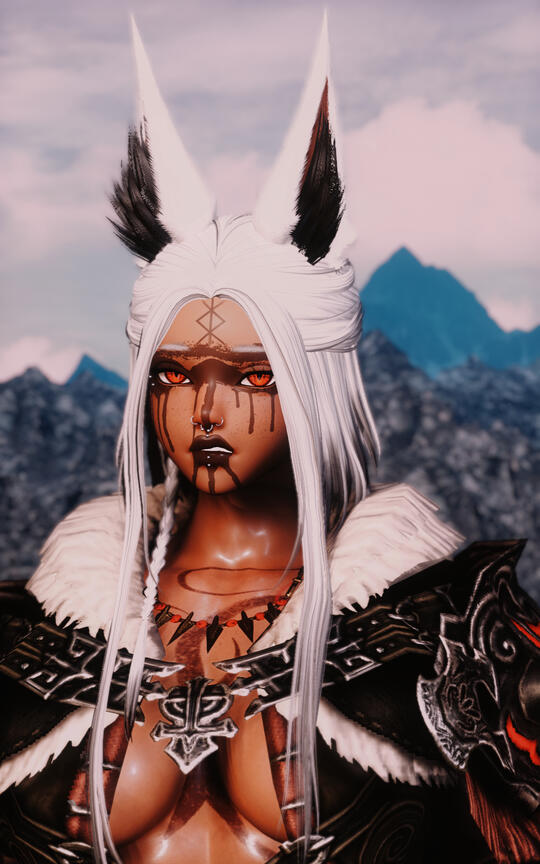
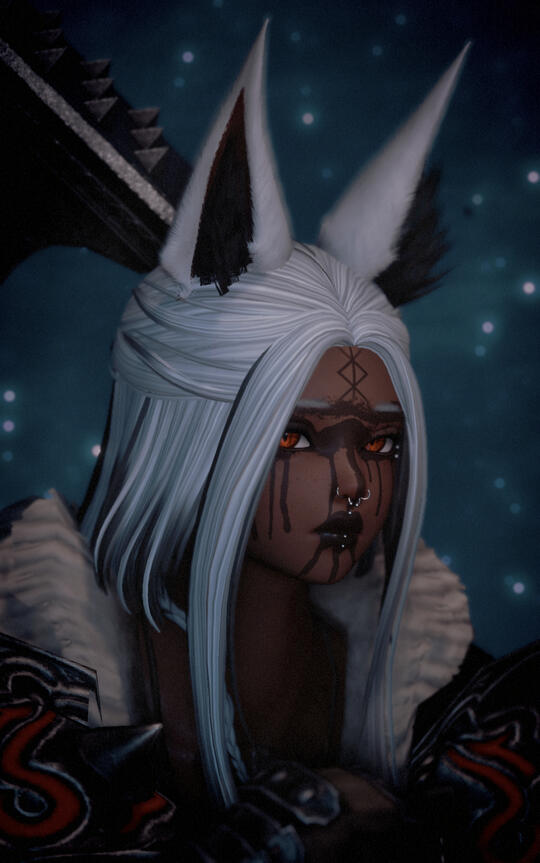
There's something strange about C'hana. Beyond the fact she has grown up far from the Western lands, so too is how she appears. Often mistaken for some hybrid or another race altogether, she is originally from Meracydia. The few, far too few who are even from such inhospitible lands may recognize the axe that she carries from her ancestors, who all forged great steel in eras past.
. Types of RP allowed: ALL but please check. .
. Please do not interact if you are a MINOR. .
dossier
. .. BASICS. Known Name . C'hana, Hana-san, "Zurmaa"
. Race . Miqo'te
. Apparent Age . 26
. Guardian . The Duskmother
. Gender . Female
. Pronouns . She/Her
. Orientation . Anyone
. Relationship . None. .. BACKGROUND. Birthplace . Meracydia
. Current Home . The Azim Steppe
. Occupation . Warrior, Beekeeper, Friend. .. PSYCHE
. Strengths . Friendly, generous, joyous, ascetic
. Weaknesses . Risk-taking, poor common tongue, bullheadedness
template made by poohsources
biogr
aphy
.. C’hana of the Ashen Hive
You can still grow wild, even when nothing around you wants you to.
Before she ever lifted the axe, C’hana knew to keep her distance from it.It rested in the corner of their tent, wrapped in oil-dark cloth, leaned carefully against the bone-framed wall. Her mother never touched it. Never spoke of it. Never gave it a name. But its presence was unmistakable, like a storm on the horizon that never quite arrived. It didn’t shine. It didn’t boast. But even at a glance, a child could tell: this was not a tool for daily use. This was a burden that waited.Her mother had come from Meracydia, and brought little with her beyond a bag of herbs, the clothes on her back, and that axe. She never told stories of the land they had fled. She didn’t share the names of those she left behind. She set up camp on the edge of the Azim Steppe, beyond the reach of clans and the rituals that tied them together. They lived alone, without recognition, and without complaint.Their life was built on careful habits—gathering, tending, making do. Her mother traded healing and honey where she could, and what she could not earn, she went without. She did not raise her voice, or ask for more. Her daughter learned the same. C’hana’s early years were shaped by quiet strength, by hard work, and by a sense of distance that never quite closed. There was care, yes—but never comfort.When the sickness came, it didn’t come like a fire. It came like dusk—gradual, creeping, inevitable. Her mother grew slower. Then unsteady. Then still.One morning, before the sun had risen, C’hana found her body cold.
There was no one to call. No rites to be given. No language to hold the moment. So she did what no one else would. She wrapped the body in the thickest blanket they owned, the one for nights when the wind cut through the tent walls like knives, and carried it up the slope behind their home. She dug with her hands until her fingers split and her palms swelled. She placed the body in the earth and built a cairn of stones. It wasn’t straight. It wasn’t beautiful. But it stood.She left a jar of honey at its base—the last one they had sealed together.Then she returned to the tent, unwrapped the axe, and tried to lift it.Her grip failed. Her shoulders caved. The haft nearly slipped from her fingers. But she gritted her teeth, widened her stance, and heaved it upright again. Not because she was ready. Not because she was strong. But because there was no one else left to carry it.She was twelve.She left the next morning and didn’t return.For a while, she vanished—wandering the Steppe without destination or name. She survived on trade and grit, too bullheaded to bend and too proud to beg. In time, she learned the weight of the axe. Her back straightened beneath it. Her arms thickened. Her stride found purpose. And though no clan ever claimed her, the more open-hearted tribes began to greet her by name.She became something like familiar. Not one of them, but not foreign either. She helped where she could—guarded caravans, tended the injured, taught children how to hold a tool without hurting themselves. In her late teens, a few stories began to follow her: the woman with the old axe and the hands that still knew how to make things grow.
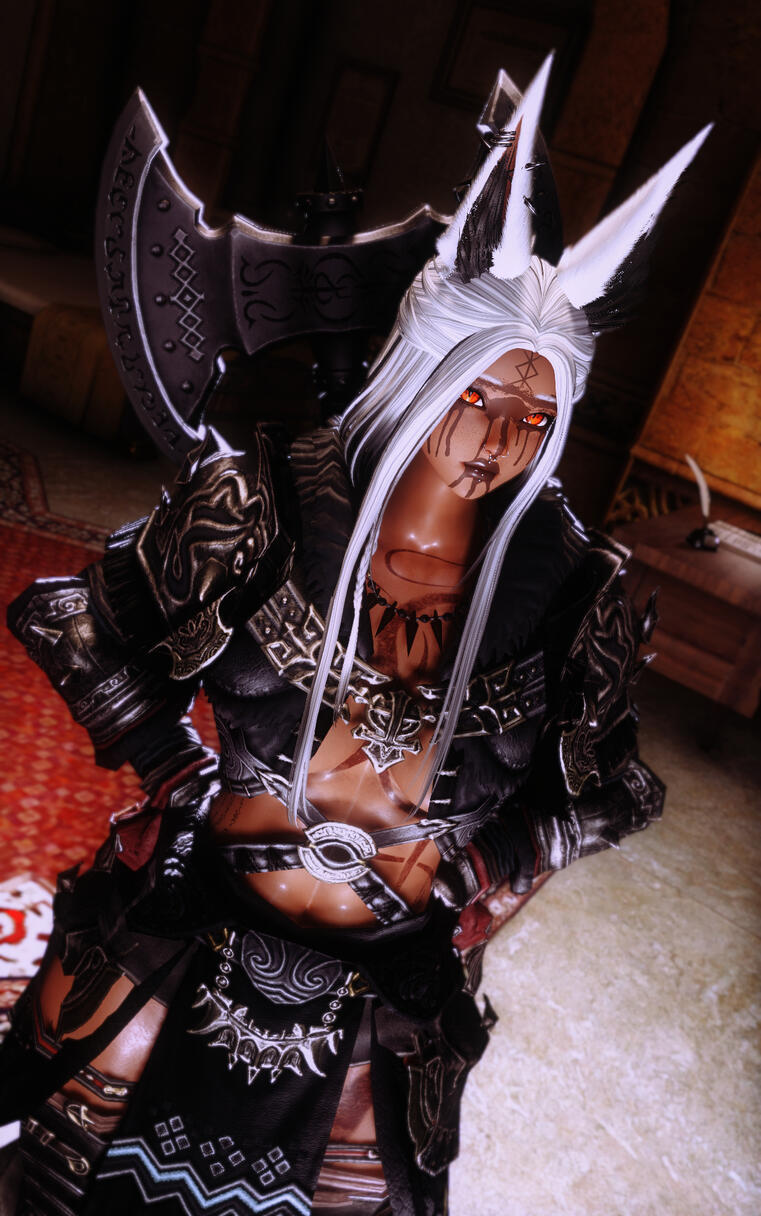
Now, at twenty-four, C’hana walks the roads of Eorzea with the same unhurried certainty she once carried across the Steppe.She is warm. Jovial. Blunt in a way that surprises people who expect a woman with such a weapon to be guarded or cold. Her Common is clumsy—stitched together with the old Auri grammar and the lilt of Steppe speech—but she doesn’t shy from speaking. She laughs often. Misuses words. Forgets the names of cities but remembers the stories of the people in them. She gets things wrong, then gets them right the next time.She calls strangers “stone-heart” or “sun-faced” without flinching, and means every word like a blessing.C’hana does not posture. She doesn’t pretend to be more refined than she is. She is who she is—scraped raw in places, softened in others, shaped by grief and grit and a defiance that never made space for shame. She still keeps bees when she can, though she no longer speaks of why. She still carries the axe—not for show, but because it is hers, and always will be.She does not chase greatness. She does not seek belonging where it is not offered freely. What she wants—what she has always wanted—is simpler than most people understand.She wants to be accepted.Not for what she’s survived. Not because of what she can do. But for the whole of her—unpolished, too much, not enough, rough-edged and still growing.She wants someone to see all of it, and stay anyway.And if they do?They’ll find someone whose loyalty roots deeper than blood.Someone who remembers.Someone who doesn’t let go.